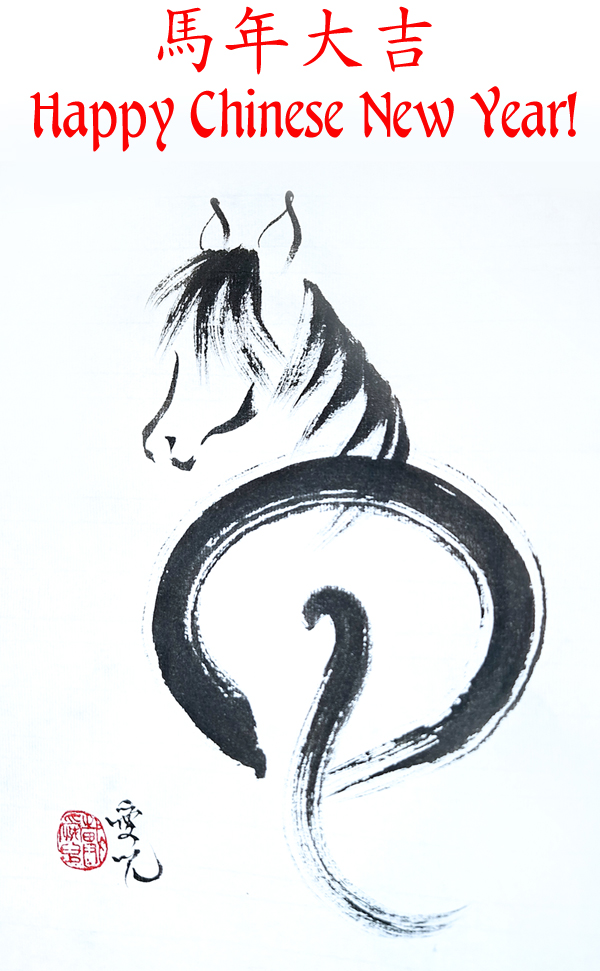
Happy Chinese New Year! It is Year of the Fire Horse !
February 17, 2026 ushers in the Year of the Horse. . The Chinese Zodiac calendar, which dates back over 2,000 years, is based on a 12-year cycle, with each year represented by an animal from the Chinese mythology.
Find out which Chinese Zodiac your birth year belongs to :
Note:The calculator is for rough conversions only. If your birthday is in January or February, you need to look up the day Chinese New Year starts for your birth year to make sure you have the correct zodiac
I have been asked if there is a difference between Chinese New Year and Lunar New Year. The answer is Yes.
The Chinese calendar is called Nongli (agricultural calendar 農曆 农历) which combines both the Yangli (solar calendar 陽曆 阳历) and Yinli (lunar calendar 陰曆 阴历) and other cycles for agricultural and social purposes. This dates back to over 2000 years ago.
The Chinese Zodiac system assigns an animal to each year in a 12 year cycle, and is based on the Chinese Calendar, not lunar calendar.
Chinese New Year does not start on January 1, but instead on a different date every year.
That's why I noted above that the calculator is for rough conversions only. If your birthday is in January or February, you need to look up the day Chinese New Year starts for your birth year to make sure you have the correct zodiac.
A small reminder to those who want to greet Chinese people Happy New Year. If you say Happy Chinese New Year, it's great! It's also great if you say Happy Year of the Horse or just Happy New Year. But if you say Happy Lunar New Year (Yinli 陰曆 阴历新年) , it has an unlucky connotation...because in Chinese, Yang (solar) is associated with brightness and life, Yin (lunar) is associated with darkness and afterlife. So it's best to wish someone good luck and brightness 🙂
Another reason is the controversy in recent years over the use of Happy Chinese New Year vs Happy Lunar New Year. There is a political trend to brand anything Chinese as bad, and to replace "Chinese New Year" with "Lunar New Year" under the guise of inclusivity. But
Chinese new year is based on the Chinese calendar and celebrations rooted in Chinese traditions. Some countries/cultures also celebrate the same new year, based on their adoption of Chinese New Year calculations and traditions. Erasing the "Chinese" from our new year does not mean inclusivity, it means refusing to acknowledge the historical origins of traditions, and lack of respect for our culture.
As someone beautifully says "respecting diverse cultures should include recognizing the history and origin of the tradition, and not erasing it."
Happy Chinese New Year!
you can download the image by right clicking on it and save